
Thinking about running a steam mop over your laminate? Hold off for a moment.
It looks like the perfect solution. Quick, chemical-free, kills bacteria, leaves floors gleaming. The problem is, laminate and steam don’t mix, and the damage often doesn’t show up until it’s too late to fix.
This guide breaks down exactly what happens when steam meets laminate, why manufacturers warn against it, and what to use instead to keep your floors looking sharp for years.
If you are looking for new laminate,carpet,vinyl, flooring or carpet accessories such as underlays in Bristol, look no further than Carpet Hub. Speak to a member of the team on 0117 379 0764 or visit our showroom in Bitton, Bristol today.
No. Steam mops should not be used on laminate flooring, and most manufacturers will void your warranty if you do.
It doesn’t matter how good the mop is or how briefly you use it.
The issue isn’t the product, it’s the combination of heat and moisture being pushed into a material that’s specifically designed to resist both at the surface only.
Laminate is built in layers. A photographic layer sits beneath a tough wear layer, and underneath that is a core made from high-density fibreboard. That core is the weak point.
Steam mops force hot vapour into the seams between planks. Even the tightest installation has microscopic gaps, and steam finds them every time. Once moisture reaches the fibreboard core, it swells, warps, and lifts at the edges. This is sometimes called peaking or cupping, and it’s permanent.
Heat is the other half of the problem. The adhesives holding the layers together soften under sustained high temperatures, which can cause delamination, where the wear layer separates from the core. You’ll notice it as bubbling, soft patches, or a hazy look that won’t polish out.
The damage usually shows up weeks or months after the steam mopping, which is why people often don’t connect the two.
Check the documentation that came with your laminate. Nearly every major manufacturer, including Quick-Step, Pergo, and Egger, explicitly states that steam mops are not approved and will void the warranty.
This isn’t a legal technicality. It’s based on testing that shows consistent damage from steam exposure, even at low settings. If you’ve ever had a flooring company refuse a warranty claim, this is one of the most common reasons.
The good news is that laminate is genuinely easy to clean once you know what works.
Most of the time, a dry approach is all you need. A soft broom, microfibre dust mop, or vacuum on a hard floor setting will handle daily dust and debris without any risk. Avoid vacuums with a rotating beater bar, as these can scratch the wear layer over time.
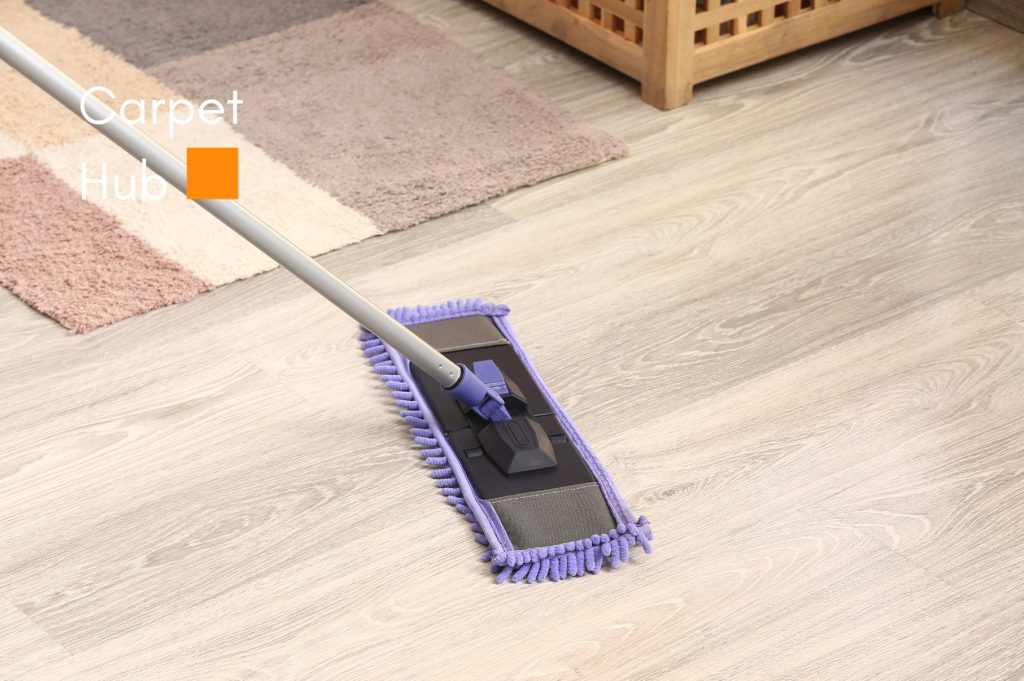
For actual cleaning, use a flat mop with a microfibre pad that’s been wrung out until it’s just damp. The pad should feel cool to the touch, not wet, and shouldn’t leave any visible water on the floor.
Plain warm water is enough for most jobs. If you need something stronger, use a cleaner specifically formulated for laminate. Apply it to the mop pad, not directly to the floor, and work in small sections.
For scuffs, sticky patches, or food spills, a slightly damp cloth and a small amount of laminate cleaner will lift most marks. Always dry the area immediately afterwards with a clean cloth. Standing moisture is the enemy, even in small amounts.
A few habits that shorten the life of laminate floors:
Steam mops. Covered above, but worth repeating.
Soaking wet mops. Even without steam, a dripping mop pushes water into the seams. If you can wring water out of the mop with your hands, it’s too wet.
Wax, polish, and oil-based products. These are designed for solid wood, not laminate.
They leave a residue that builds up, dulls the finish, and can make the floor slippery.
Bleach and ammonia. Both strip the protective layer and can leave permanent marks. Stick to pH-neutral cleaners made for laminate.
Abrasive pads or scrubbers. Anything rough enough to scratch a wine glass will scratch the wear layer.
Cleaning Method | Safe for Laminate? |
Steam mop | No |
Microfibre dust mop | Yes |
Damp flat mop (well wrung out) | Yes |
Wet string mop | No |
Vacuum (hard floor setting) | Yes |
Vacuum with beater bar | No |
Laminate-specific cleaner | Yes |
Bleach or ammonia | No |
Steam mops and laminate flooring are a bad combination, full stop. The damage isn’t always immediate, but it’s almost always permanent once it appears. Warped planks, lifted edges, and delamination can’t be reversed, only replaced.
The fix is simple. Stick to dry cleaning where possible, use a damp microfibre mop when you need more, and avoid anything that pushes moisture or heat into the seams. Do that, and a good laminate floor will hold up for fifteen to twenty years or more.
Looking for new laminate, flooring, or carpet accessories like underlays in Bristol?
Carpet Hub has you covered. Give our team a call on 0117 379 0764, or visit our showroom in Bitton, Bristol to explore our range and get expert advice.
Yes. The temperature is lower, but moisture still penetrates the seams. Manufacturers don’t distinguish between settings, any steam use voids the warranty.
No. Waterproof laminate resists spills and standing water on the surface, but the seams and core are still vulnerable to pressurised steam. Check your specific product documentation, but almost all waterproof laminates still exclude steam cleaning.
A flat microfibre mop with a removable, washable pad. They hold the right amount of moisture, glide easily, and don’t leave streaks. Avoid string mops and sponge mops, which hold too much water.
It’s not worth the risk. Damage from steam is cumulative, and the cost of replacing affected planks far outweighs the convenience of using one. A damp microfibre mop does the same job safely.