
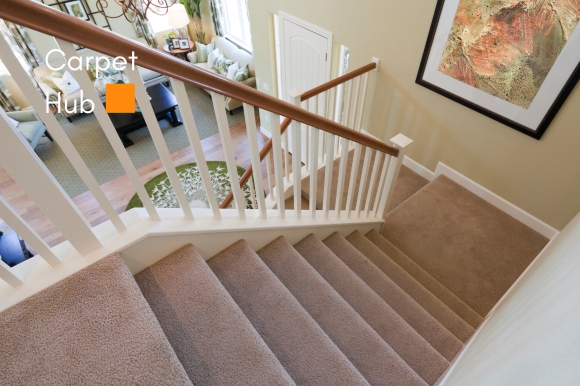
Picking carpet for a staircase is not the same job as picking it for a bedroom. Get it wrong and you will see the difference within months.
Stairs take more punishment than any other surface in a home. Every footstep lands in roughly the same place, day after day, so the wrong carpet flattens, frays and looks tired long before the rest of the house does. The right one holds its shape, grips underfoot and pulls the whole space together.
This guide covers the three things that genuinely matter when you choose a stair carpet: how long it lasts, how safe it is to walk on, and how good it looks. By the end you will know what to look for and which Carpet Hub ranges are built for the job.
If you are looking for new carpet, vinyl, flooring or carpet accessories such as underlays in Bristol, look no further than Carpet Hub. Speak to a member of the team on 0117 379 0764 or visit our showroom in Bitton, Bristol today.
The best carpet for stairs is a dense twist pile in a hard-wearing fibre, fitted over a quality underlay.
That combination copes with constant footfall, resists crushing on the nosing (the front edge of each step), and gives you the grip you want on the part of the home where a slip causes the most harm.
Deep, soft piles and loop piles look lovely in a bedroom, but they tend to struggle on a busy set of stairs.
Stairs concentrate wear in a way that no flat floor does.
On a landing or in a lounge, footfall spreads across a wide area. On a staircase it lands on the same narrow strip of every step, and most of the pressure hits the nosing. That single point of contact is where carpets first develop bald patches, shading and frayed edges.
The angle adds to it. As people climb, the pile is pushed and dragged rather than simply pressed down, so a fibre that recovers well on the flat can still flatten on a stair. This is the main thing that separates a carpet that lasts fifteen years from one that looks worn out in two.
A few features tell you whether a carpet can handle the workload.
Twist pile. Twist (sometimes called twisted pile) is the most reliable choice for stairs. The tightly turned yarn springs back after each step and hides footprints and vacuum lines well. Avoid loop pile here, as the loops can snag on the nosing and pull.
Density and weight. Press your fingers into the carpet. A dense pile resists you and feels firm. The closer the tufts sit together, the harder it is for footfall to part them and expose the backing. Heavier carpets generally last longer on stairs for the same reason.
The right fibre. Polypropylene and good quality polyamide (nylon) both shrug off heavy use and clean easily, which makes them sensible picks for family homes. Wool and wool-rich blends sit at the premium end and offer excellent resilience and a softer feel, though they ask for a little more care.
Quality underlay. Underlay is the part most people forget, yet it does a lot of the work. A firm, dense underlay supports the carpet on the nosing, slows down wear and stops the pile bottoming out under your weight. A cheap, spongy underlay lets the carpet move and ages it faster.
Stairs are where carpet choice stops being about looks and starts being about keeping people on their feet.
A shorter, denser pile gives a more stable, predictable footing than a long shaggy one, where your foot can sink and shift. That matters most for young children, older relatives and anyone carrying a basket of washing down in the dark.
Fitting is just as important as the carpet itself. A stair carpet should be stretched tight and wrapped firmly over each nosing so there is no loose section to trip on. A professional fit also tucks and secures the edges so they cannot lift. This is one job we would always steer you away from doing yourself.
If you are choosing between a full-width fitted carpet and a runner, think about who uses the stairs. A fitted carpet covers the whole tread and is the safer, warmer option for most homes. A runner looks smart on a wooden staircase but leaves bare timber on either side, which can be slippery in socks.
Durable and safe does not have to mean dull. Stair carpet sets the tone for your hallway, so it is worth getting the look right.
Colour. Mid tones hide everyday marks far better than very pale or very dark shades, which show fluff and footprints. Greys, soft beiges and warm neutrals stay looking clean between cleans and work with almost any decor. For inspiration on pairing flooring with your furniture, our guide on what carpet goes with a grey sofa is a useful starting point.
Flow through the home. Stairs usually connect a hallway to a landing, so the carpet is visible from several rooms at once. Many people choose the same carpet, or a close match, across the stairs, hall and landing to make the space feel larger and more joined up.
Pattern and texture. A subtle stripe or fleck adds interest and hides marks even better than a plain colour. Bold patterns can look stunning on a runner, but on a fitted stair carpet they are harder to align neatly around the turns.
A few examples from our site that tick the durability, safety and style boxes:
Pop into the showroom and our team will walk you through which option suits how you live and how busy your stairs are.
A few choices that shorten the life of a stair carpet, or make it less safe:
Feature | Best for stairs? |
Dense twist pile | Yes |
Loop pile | No |
Deep shaggy pile | No |
Polypropylene or nylon | Yes |
Wool / wool blend | Yes (premium) |
Quality dense underlay | Yes |
Thin budget underlay | No |
Mid-tone or flecked colour | Yes |
Very pale or very dark plain | Not ideal |
Professional fitting | Yes |
The best carpet for stairs comes down to three things working together: a dense twist pile for durability, a secure professional fit for safety, and a mid-tone or textured finish for style. Get those right and a good stair carpet will look sharp and stay safe for fifteen to twenty years.
The mistake most people make is treating the stairs like any other room. They are the hardest-working surface in the house, so they deserve a carpet built for the job and an underlay that supports it.
Looking for new carpet, laminate, flooring, or carpet accessories like underlays in Bristol?
Carpet Hub has you covered. Give our team a call on 0117 379 0764, or visit our showroom in Bitton, Bristol to explore our range and get expert advice.
A dense twist pile in polypropylene, nylon or a wool blend. Twist pile springs back after each step, resists crushing on the nosing and hides footprints, which makes it the most durable choice for heavy use.
It is not the best option. The loops can snag and pull on the front edge of each step, and over time that leaves runs and frayed patches. A cut twist pile is a safer, longer-lasting choice.
Yes. A firm, dense underlay supports the carpet over the nosing, slows down wear and stops the pile bottoming out. It is one of the most overlooked parts of a stair carpet and well worth the investment.
Yes, and many people do. Running one carpet across all three makes the space feel larger and more joined up, and it simplifies the order. Just make sure it is a pile rated for heavy traffic.